Meditate on God's Word
Take a few quiet moments to reflect on today's message. Allow the Holy Spirit to speak to your heart as you read.
Reading time
10 min read
Introduction
A city is more than buildings, roads and streets. A city is a community of people whose character determines the identity of that city.
In Isaiah 1, God speaks about Jerusalem. It was once known as a city of righteousness and faithfulness, but corruption, injustice, idolatry and rebellion had entered into it. The people had drifted away from God's original intention.
Yet God did not abandon the city.
He promised restoration:
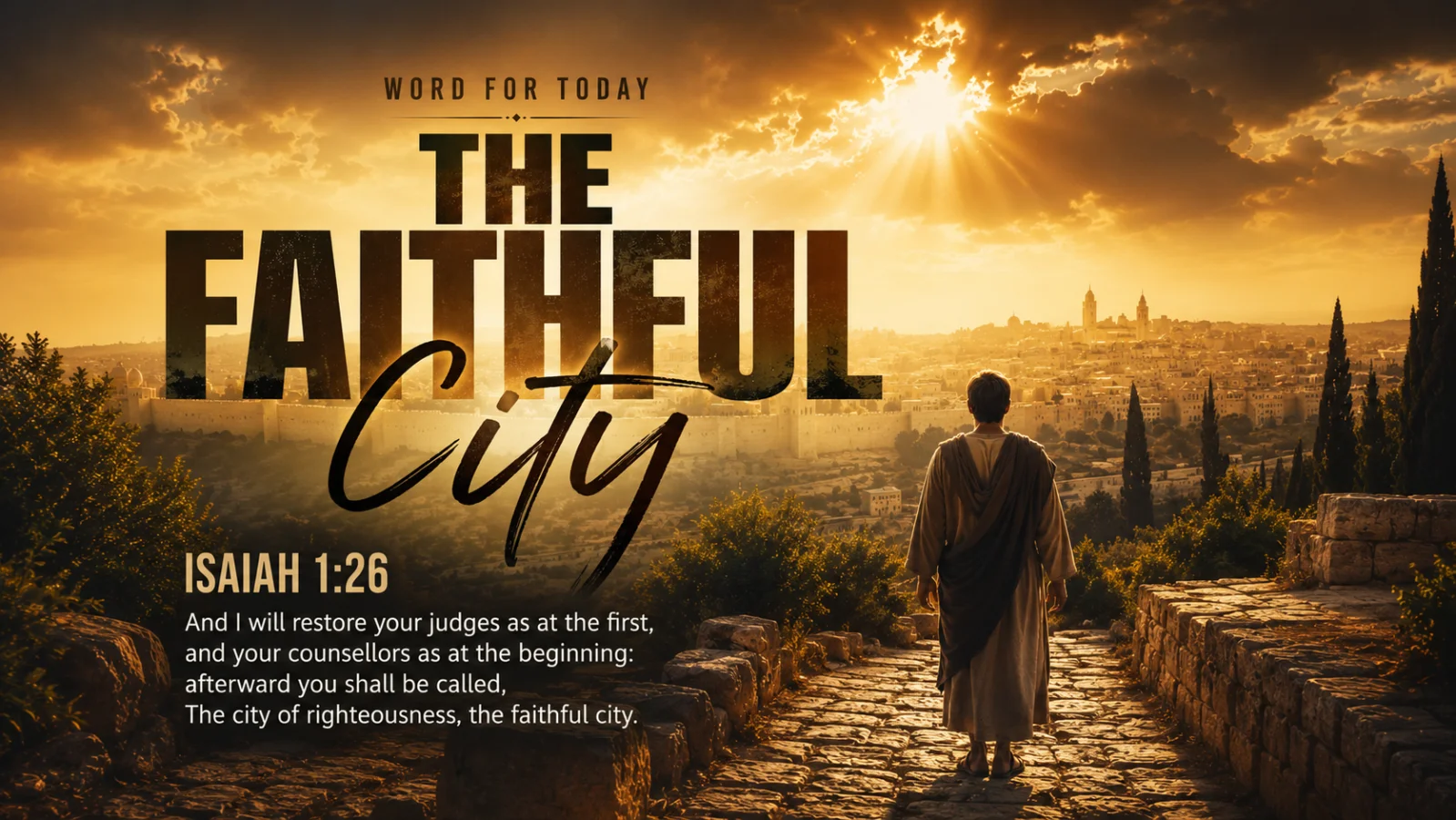
"And I will restore your judges as at the first, and your counsellors as at the beginning..."
Then He declared what the city would become:
"The city of righteousness, the faithful city."
This teaches us something powerful: God is interested not only in what we are now, but in what we can become when He restores us.
A person may have failed. A family may have fallen apart. A church may have lost its fire. A generation may have wandered from God. But when God begins His work of restoration, He can bring back righteousness, integrity and faithfulness.
The question today is not simply, "Are we blessed?"
The greater question is:
"Can God call us faithful?"
1. A FAITHFUL CITY BEGINS WITH A RETURN TO GOD
Jerusalem had not always been in the condition described in Isaiah 1. Something had gone wrong.
The people had become religious without being righteous. They offered sacrifices, observed religious activities and continued their ceremonies, but their hearts were far from God.
Isaiah 1:11-17 makes it clear that God was not impressed by their outward religious activities because their lives contradicted their worship.
This is a warning to us.
It is possible to have the appearance of Christianity without the character of Christ.
We can attend church and still be far from God.
We can preach about holiness and secretly practise sin.
We can sing about faithfulness and live in compromise.
We can carry a Bible without allowing the Bible to govern our lives.
God was therefore calling Jerusalem back.
Isaiah 1:16 says:
"Wash yourselves; make yourselves clean; put away the evil of your doings from before my eyes; cease to do evil."
Before there could be restoration, there had to be repentance.
Faithfulness begins where genuine repentance begins.
You cannot build a faithful life while deliberately holding on to the things God has asked you to abandon.
If we want to become a faithful city, a faithful church, a faithful family and faithful individuals, we must first return to God.
2. GOD WANTS TO RESTORE WHAT SIN HAS DESTROYED
One of the most beautiful things about Isaiah 1:26 is that God did not merely expose Jerusalem's failure. He promised restoration.
"I will restore..."
That is the language of hope.
God saw the brokenness, but He also saw the possibility of restoration.
Perhaps something has been damaged in your life.
Your prayer life may not be what it used to be.
Your passion for God's Word may have declined.
Your family may have experienced difficult seasons.
Your integrity may have been compromised.
Your relationship with God may have become cold.
The good news is that failure does not have to be the final chapter.
God is a restorer.
Joel 2:25 says:
"And I will restore to you the years that the locust hath eaten..."
God can restore lost years.
He can restore broken relationships.
He can restore spiritual hunger.
He can restore holiness.
He can restore purpose.
He can restore integrity.
He can restore what sin, disappointment and disobedience have damaged.
But restoration does not mean returning to exactly what we were before.
Sometimes God restores us by making us wiser, stronger and more dependent upon Him than we were before.
3. A FAITHFUL CITY NEEDS FAITHFUL LEADERS
Notice what God said first:
"I will restore your judges as at the first, and your counsellors as at the beginning."
Why judges and counsellors?
Because leadership affects the condition of a society.
When leaders become corrupt, corruption spreads.
When leaders become dishonest, dishonesty becomes normal.
When leaders abandon righteousness, people begin to lose their moral direction.
But when leaders return to God, they can become instruments of restoration.
This applies not only to government.
It applies to pastors.
It applies to parents.
It applies to husbands and wives.
It applies to teachers.
It applies to business owners.
It applies to anyone entrusted with influence.
Every position of influence is also a position of responsibility.
A faithful leader does not merely ask, "What can I gain?"
A faithful leader asks, "What has God entrusted to me, and how will I account for it?"
The church needs faithful ministers.
Families need faithful fathers and mothers.
Businesses need faithful people.
Society needs faithful leaders.
And God is still looking for people whom He can trust.
4. FAITHFULNESS IS MORE THAN APPEARANCE
A city can look beautiful from the outside while being broken within.
The same can happen to a person.
We can maintain an impressive public image while our private lives are falling apart.
But God does not judge us by appearance alone.
1 Samuel 16:7 reminds us:
"For man looks on the outward appearance, but the LORD looks on the heart."
Faithfulness is therefore a matter of the heart.
It is who you are when nobody is watching.
It is what you do when there is no applause.
It is whether you keep your word when keeping it becomes inconvenient.
It is whether you remain honest when dishonesty would benefit you.
It is whether you remain pure when temptation presents itself.
It is whether you remain committed when emotions disappear.
It is whether you continue serving God when nobody recognises your service.
Faithfulness is proven in private before it is recognised in public.
Joseph was faithful when nobody was watching.
Daniel remained faithful when it could cost him his life.
Ruth remained faithful when she could have walked away.
David learned faithfulness in the wilderness before he sat on the throne.
God often develops faithfulness in hidden places before revealing it in public places.
5. A FAITHFUL CITY IS A CITY OF RIGHTEOUSNESS
God did not say Jerusalem would simply become a successful city.
He said:
"You shall be called, The city of righteousness, the faithful city."
Righteousness comes before reputation.
God was not primarily interested in Jerusalem being famous. He wanted Jerusalem to be righteous.
This challenges the values of our generation.
We often measure success by money, influence, followers, possessions, buildings and achievements.
But God's measurement is different.
Heaven celebrates righteousness.
Proverbs 14:34 says:
"Righteousness exalts a nation: but sin is a reproach to any people."
A nation does not become great merely because it has wealth.
A church does not become great merely because it has a large congregation.
A person does not become great merely because they have influence.
True greatness begins with righteousness.
What would happen if our homes became places of righteousness?
What would happen if our churches became centres of holiness?
What would happen if our businesses became examples of integrity?
What would happen if our leaders became servants rather than self-seekers?
What would happen if Christians became known for honesty, purity, compassion and faithfulness?
We would begin to see the kind of transformation God intended.
6. GOD WANTS US TO BE FAITHFUL IN AN UNFAITHFUL GENERATION
One of the greatest challenges of faithfulness is living faithfully when everybody around you is compromising.
It is easy to follow God when everybody is following God.
The real test comes when obedience makes you different.
Noah lived faithfully in a corrupt generation.
Genesis 6:9 says:
"Noah was a just man and perfect in his generations, and Noah walked with God."
Daniel lived faithfully in Babylon.
Joseph maintained his integrity in Egypt.
The three Hebrew men refused to bow to Nebuchadnezzar's image.
Their environment did not determine their character.
Babylon was around Daniel, but Babylon did not get inside Daniel.
That is the challenge for the believer today.
We live in a world where compromise is increasingly normalised.
But our environment must not determine our convictions.
We are called to be light in darkness.
We are called to be salt in a decaying world.
We are called to remain faithful even when faithfulness becomes unpopular.
7. FAITHFULNESS MUST BE MAINTAINED UNTIL THE END
It is not enough to start well.
We must finish well.
Many people begin with enthusiasm but lose their commitment along the way.
Some begin with fire but become cold.
Some begin with holiness but compromise.
Some begin with humility but become proud.
Some begin serving God but eventually serve themselves.
Paul said in Acts 20:24:
"But none of these things move me, neither count I my life dear unto myself, so that I might finish my course with joy..."
The goal is not simply to start the race.
The goal is to finish faithfully.
Jesus said in Revelation 2:10:
"Be thou faithful unto death, and I will give thee a crown of life."
Faithfulness has a reward.
God sees every sacrifice.
He sees every prayer.
He sees every temptation you resisted.
He sees every time you chose integrity over profit.
He sees every time you forgave.
He sees every time you continued serving despite disappointment.
He sees.
And the God who sees faithfulness will reward faithfulness.
HOW CAN WE BECOME A FAITHFUL CITY?
1. Return to God's Word
Let Scripture become the standard for our lives rather than culture.
2. Practise genuine repentance
Do not defend what God is asking you to surrender.
3. Pursue holiness
Do not make peace with the things that destroy your relationship with God.
4. Become people of integrity
Let your public life and private life tell the same story.
5. Keep your commitments
Your word should mean something.
6. Remain faithful when nobody is watching
Character is revealed in secret places.
7. Finish what God has entrusted to you
Do not abandon your assignment because the journey became difficult.
CONCLUSION
Isaiah 1 presents us with a city that had fallen away from God's standard.
But God did not end the story with judgment.
He promised restoration.
"I will restore..."
And after restoration:
"You shall be called, The city of righteousness, the faithful city."
This is God's desire.
He wants to take what has been corrupted and restore it.
He wants to take what has become spiritually cold and set it on fire again.
He wants to take broken lives and make them testimonies.
He wants to take families that have lost their way and bring them back.
He wants His Church to become a faithful witness in an unfaithful generation.
But the question is personal.
Can God trust you?
Can He trust you with blessing?
Can He trust you with influence?
Can He trust you with money?
Can He trust you with another person's heart?
Can He trust you with leadership?
Can He trust you when nobody is watching?
Can He trust you when obedience costs you something?
Can He trust you when the answer to your prayer is delayed?
Can He trust you until the end?
May our lives become places where righteousness dwells.
May our homes become houses of faithfulness.
May our churches become communities of holiness.
May our generation encounter people whose lives prove that God can still produce faithful people.
And when God looks at us, may He not only see what we claim to be, but what we truly are.
May He be able to call us His faithful people.