Meditate on God's Word
Take a few quiet moments to reflect on today's message. Allow the Holy Spirit to speak to your heart as you read.
Reading time
9 min read
Introduction
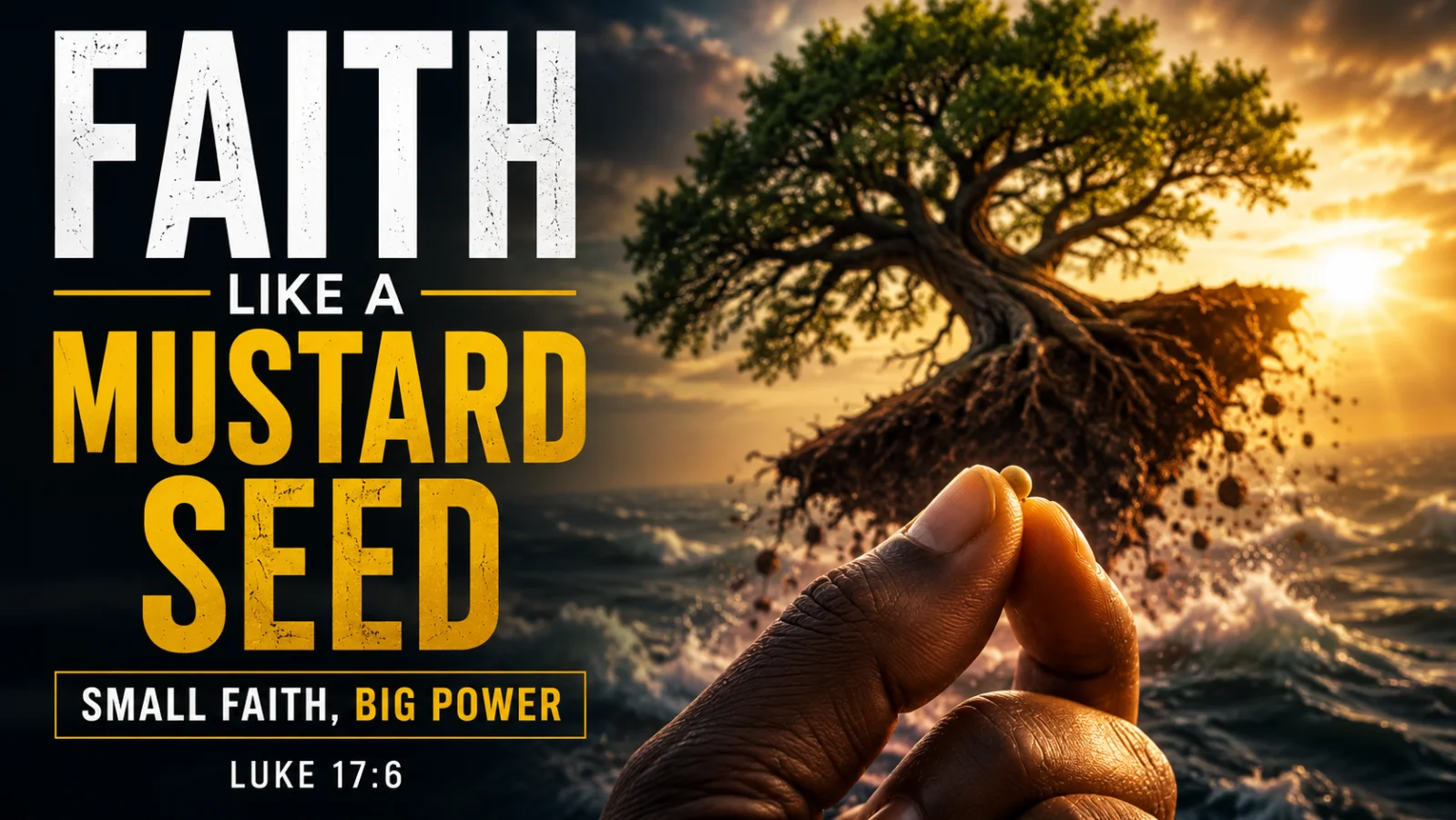
Faith is one of the most powerful subjects in the Christian life. We often talk about having great faith, strong faith, mountain-moving faith and unwavering faith. But in Luke 17:6, Jesus introduces us to something that sounds surprisingly small: faith like a mustard seed.
Jesus was not saying that we should have a tiny amount of faith. He was teaching us that the effectiveness of faith is not determined by its size alone, but by the God in whom that faith is placed.
A mustard seed is tiny, yet it carries within it the potential to become something much larger.
In the same way, your faith may appear small today. You may look at your circumstances and wonder, “Can this little faith really change anything?”
Jesus says, yes.
The question is not simply, “How big is your faith?”
The greater question is:
“How great is the God you are trusting?”
1. FAITH MAY BEGIN SMALL
The mustard seed was known for its smallness. Jesus deliberately used something tiny to illustrate something spiritually powerful.
This teaches us that faith does not have to begin big. It has to begin.
Sometimes we disqualify ourselves because our faith does not look like someone else's.
Someone may pray boldly, while you struggle to pray.
Someone may confidently declare God's promises, while you are still wrestling with doubt.
Someone may have experienced a great miracle, while you are still waiting for your own testimony.
Do not despise the beginning of your faith.
A small faith placed in a great God is better than great confidence placed in yourself.
Remember the man who came to Jesus concerning his demon-possessed son. He cried:
“Lord, I believe; help thou mine unbelief.”
Mark 9:24
That was not perfect faith, but it was honest faith.
He brought what he had to Jesus.
And sometimes that is exactly what God is asking from you.
Bring Him your little faith.
You may not understand everything.
You may not see the answer.
You may still have questions.
But if you can say, “Lord, I trust You,” you have begun.
2. FAITH MUST BE PLANTED IN GOD
The power of faith is not in faith itself.
Faith is not a mystical force.
Faith is not positive thinking.
Faith is not pretending that problems do not exist.
Faith is confidence in God.
A person can have tremendous confidence and still be confidently wrong.
But biblical faith rests upon the character, power and promises of God.
Hebrews 11:1 says:
“Now faith is the substance of things hoped for, the evidence of things not seen.”
Faith looks beyond what the eyes can see and trusts what God has said.
Peter demonstrated this when Jesus told him to come out of the boat and walk upon the water.
As long as Peter's eyes were fixed on Jesus, he walked on what should have been impossible.
But when he began to focus on the wind and waves, he began to sink.
The storm was real.
The waves were real.
The danger was real.
But Jesus was greater than all of them.
Faith does not deny the existence of the storm. Faith declares that the storm is not greater than God.
3. FAITH SPEAKS TO IMPOSSIBILITIES
Jesus said:
“If ye had faith as a grain of mustard seed, ye might say unto this sycamine tree, Be thou plucked up by the root...”
Notice the language Jesus used:
“Ye might say.”
There is a place for speaking faith.
This does not mean that we manipulate God with words or use declarations as magic formulas.
It means that genuine faith produces a response.
When you believe God's Word, you begin to speak differently.
David stood before Goliath and did not speak according to the size of Goliath. He spoke according to the greatness of his God.
Goliath said, “I will defeat you.”
David essentially said, “You have come with weapons, but I have come in the name of the Lord.”
The difference was not David's physical strength.
It was the object of his confidence.
Faith says:
“This situation is difficult, but God is greater.”
Faith says:
“I cannot see the way, but God knows the way.”
Faith says:
“I do not have the strength, but God's grace is sufficient.”
Faith says:
“The door looks closed, but God can make a way.”
4. FAITH DEALS WITH ROOTS, NOT JUST FRUIT
Jesus said the sycamine tree should be “plucked up by the root.”
That is significant.
Sometimes we pray only about what is visible.
But God wants to deal with what is underneath.
You may see anger, but there may be a root of bitterness.
You may see repeated failure, but there may be a root of fear.
You may see confusion, but there may be a root of wrong thinking.
You may see a broken relationship, but there may be years of unforgiveness underneath it.
We often ask God to cut off the fruit while He wants to remove the root.
Faith trusts God enough to allow Him to deal with what is beneath the surface.
Perhaps there is something in your life that has been there for years.
Perhaps you have prayed about it repeatedly.
Perhaps you have begun to think, “This is just the way I am.”
But Jesus says that even a deeply rooted tree can be uprooted.
Do not allow the longevity of a problem to convince you that it is beyond God's power.
What has been rooted for years is still subject to the authority of God.
5. FAITH GROWS THROUGH USE
A mustard seed does not remain a mustard seed forever.
It grows.
That is one of the beautiful pictures Jesus gives us.
Your faith is not meant to remain at the level where it began.
Romans 10:17 says:
“So then faith cometh by hearing, and hearing by the word of God.”
Faith grows when you hear God's Word.
Faith grows when you obey God.
Faith grows when you remember what God has already done.
Faith grows when you pray.
Faith grows when you walk through difficult seasons and discover that God is still faithful.
You may begin by trusting God with something small.
Then you discover that He is faithful.
That experience strengthens your confidence.
Then another challenge comes.
You trust Him again.
And gradually, your faith develops.
Faith grows when it is exercised.
You cannot build strong spiritual muscles by simply talking about exercise.
You must exercise.
In the same way, you cannot develop strong faith merely by hearing sermons about faith.
You must trust God in real situations.
6. FAITH DOES NOT MEAN THE ABSENCE OF QUESTIONS
Sometimes Christians feel guilty because they have questions.
But having questions does not necessarily mean that you have no faith.
Faith does not mean you understand everything.
Faith means you trust God even when you do not understand everything.
Job experienced unimaginable suffering and asked difficult questions.
David repeatedly asked God, “How long?”
The disciples themselves struggled with fear and uncertainty.
Yet God continued to work with them.
There may be moments when your faith sounds like a triumphant declaration.
There may also be moments when your faith sounds like:
“Lord, I don't understand, but I still trust You.”
That is faith.
You do not have to pretend.
Bring your questions to God.
Bring your fears to God.
Bring your weakness to God.
Bring your little mustard seed of faith to God.
7. FAITH OBEYS GOD
Faith is more than believing that God can.
Faith also means trusting Him enough to obey Him.
Hebrews 11 repeatedly describes people who acted because they believed God.
Noah built an ark because he believed God's warning.
Abraham left his country because he believed God's promise.
Moses rejected the treasures of Egypt because he believed God's greater purpose.
Peter stepped out of the boat because Jesus said, “Come.”
Faith eventually produces movement.
There are things God may be asking you to do that require faith.
Forgive.
Start again.
Pray again.
Serve again.
Trust again.
Step out.
Speak.
Wait.
Give.
Obey.
Sometimes the miracle begins when you take the first step of obedience.
8. FAITH DOES NOT MAKE GOD SMALLER THAN YOUR PROBLEM
The disciples looked at the storm and became afraid.
David looked at Goliath and saw an opportunity to demonstrate God's power.
The ten spies looked at Canaan and saw giants.
Joshua and Caleb looked at the same land and saw God's promise.
The circumstances were the same.
The difference was perspective.
Fear magnifies the problem and minimises God.
Faith magnifies God and puts the problem in its proper place.
Your problem may be large.
But God is larger.
Your mountain may be high.
But God is higher.
Your resources may be small.
But God is not limited by your resources.
Your understanding may be limited.
But God's wisdom is unlimited.
Your strength may fail.
But God's strength never fails.
That is why Jesus says, “faith as a grain of mustard seed.”
It is not about how impressive your faith looks.
It is about the One your faith is connected to.
CONCLUSION
The mustard seed teaches us a powerful lesson:
Never underestimate what God can do with what you are willing to give Him.
Perhaps your faith feels small today.
Perhaps you are waiting for an answer.
Perhaps you have prayed about the same situation for a long time.
Perhaps something in your life looks deeply rooted and impossible to remove.
Do not throw away your faith because it looks small.
Give it to God.
A mustard seed may be small, but it carries potential.
Your faith may feel weak, but God is strong.
Your resources may be limited, but God is unlimited.
Your understanding may be incomplete, but God sees the whole picture.
Your situation may look impossible, but nothing is impossible with God.
Jesus did not say you need faith as big as a mountain.
He said faith as a grain of mustard seed.
So start where you are.
Trust God with what you have.
Believe His Word.
Obey His instruction.
Keep praying.
Keep walking.
Keep trusting.
And when you cannot see the answer, remember:
Faith does not require you to see the whole road. It requires you to trust the One who knows where the road leads.