
Meditate on God's Word
Take a few quiet moments to reflect on today's message. Allow the Holy Spirit to speak to your heart as you read.
Reading time
8 min read
Introduction
The Psalmist, David, was facing people who were not merely opposed to him, but were deliberately working evil against him. They had made themselves instruments of wickedness, and their intention was to destroy him.
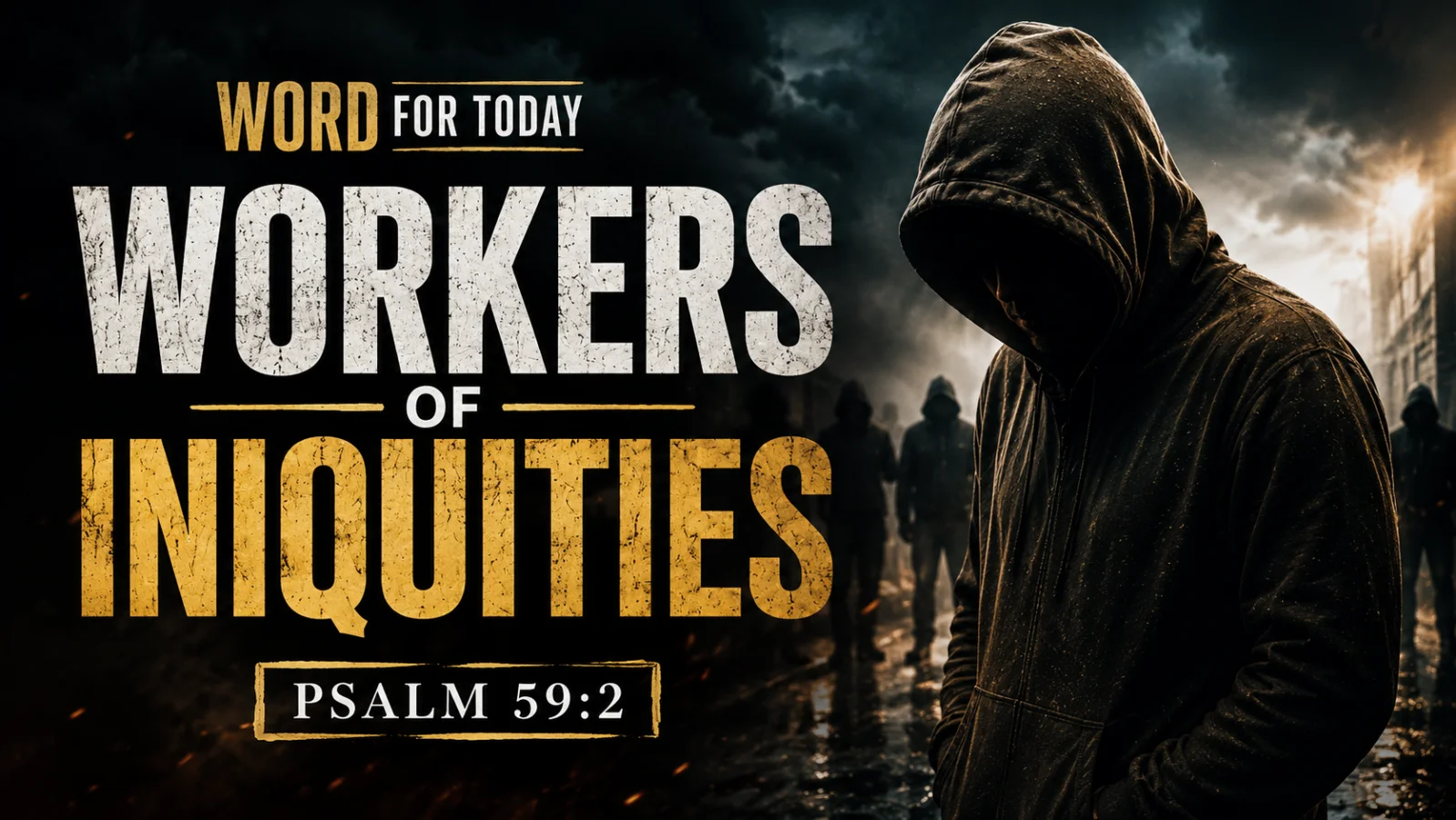
David therefore cried to God: "Deliver me from the workers of iniquity."
This prayer reveals something important. There are people who do not merely commit wrong occasionally. They have become workers of iniquity. Iniquity has become their pattern, their practice and, in some cases, their assignment.
A worker is someone who is actively engaged in something. Therefore, a worker of iniquity is someone who deliberately engages in wickedness and makes evil a consistent practice.
The Bible does not only warn us about the works of darkness. It also teaches us to recognise those who have given themselves to such works.
1. WHAT IS INIQUITY?
Iniquity is more than making a mistake.
A mistake may happen through ignorance, weakness or carelessness. But iniquity speaks of deliberate, persistent and morally crooked behaviour.
Psalm 51:5 reveals the seriousness of sin, while Isaiah 59:2 shows how iniquity can create separation between man and God.
There is a difference between falling into sin and building a lifestyle around sin.
A believer may stumble, but he does not make peace with the ground.
The danger begins when a person stops fighting sin and starts defending it.
When someone says:
"This is just the way I am."
"Everybody does it."
"God understands."
"I will change later."
That person may be moving from committing sin to becoming a worker of iniquity.
2. WORKERS OF INIQUITY WORK DELIBERATELY
David did not call them merely "sinners". He called them workers of iniquity.
They were organised around evil.
Psalm 59:3 says:
"For, lo, they lie in wait for my soul."
Their actions were intentional. They were watching, planning and waiting for an opportunity to attack David.
This teaches us that some opposition in life is not accidental.
There are people who deliberately plan evil.
They plan how to destroy someone's reputation.
They plan how to manipulate others.
They plan how to take advantage of someone's weakness.
They plan how to cause division.
They plan how to deceive.
That is why spiritual discernment is necessary.
Not everybody who smiles at you is necessarily for you, and not everybody who speaks softly has peaceful intentions.
Jesus said:
"Behold, I send you forth as sheep in the midst of wolves: be ye therefore wise as serpents, and harmless as doves."
Matthew 10:16
We must remain loving, but we must not become foolish.
3. WORKERS OF INIQUITY CAN EXIST IN PLACES OF INFLUENCE
One of the most uncomfortable truths in Scripture is that wickedness can operate through people in positions of influence.
David's enemies were not strangers with no access to him. They were people connected to the environment in which he lived.
The Bible repeatedly demonstrates that evil can operate through:
political systems,
families,
workplaces,
friendships,
religious institutions,
business relationships,
and even close associations.
Judas walked with Jesus.
Absalom was David's son.
Saul was once connected to David through marriage and leadership.
The lesson is not that everyone around us is evil.
The lesson is that proximity does not automatically mean loyalty.
Someone can be close to you physically and far from you in purpose.
Therefore, do not measure loyalty merely by proximity. Measure it by character, fruit and consistency.
4. WORKERS OF INIQUITY OFTEN HIDE BEHIND APPEARANCES
Some people do not look dangerous.
They may dress well.
They may speak intelligently.
They may quote Scripture.
They may appear religious.
They may even occupy respected positions.
But Jesus warned:
"Beware of false prophets, which come to you in sheep's clothing, but inwardly they are ravening wolves."
Matthew 7:15
The problem with a wolf is not that it looks like a wolf.
The problem is that it can look like a sheep.
This is why spiritual discernment is more important than outward appearance.
A person can have a beautiful presentation and a corrupt heart.
A person can have religious vocabulary and wicked intentions.
A person can know Scripture and still refuse to obey God.
Therefore, Jesus said:
"Ye shall know them by their fruits."
Matthew 7:16
Character eventually reveals what appearance tries to conceal.
5. DO NOT BECOME A WORKER OF INIQUITY WHILE FIGHTING ONE
This is where the message becomes personal.
It is easy to preach against wicked people while ignoring wickedness developing in our own hearts.
David prayed for deliverance from the workers of iniquity, but Scripture also challenges us to examine ourselves.
Jesus warned:
"Not every one that saith unto me, Lord, Lord, shall enter into the kingdom of heaven."
Matthew 7:21
There is a difference between calling Jesus Lord and living under His lordship.
We must therefore ask ourselves:
Am I becoming what I am praying against?
Am I praying against hatred while carrying hatred?
Am I praying against deception while deceiving others?
Am I praying against immoral people while secretly entertaining immorality?
Am I condemning unforgiveness while refusing to forgive?
Am I asking God to expose wickedness while protecting my own secret sin?
God does not want us merely to escape the workers of iniquity.
He wants us to escape the work of iniquity itself.
6. GOD CAN DELIVER YOU FROM THE WORKERS OF INIQUITY
David's prayer was simple:
"Deliver me from the workers of iniquity."
He understood that some battles cannot be solved by human strength.
There are situations where you need God's intervention.
God can expose hidden plans.
God can frustrate evil intentions.
God can separate you from destructive relationships.
God can give you wisdom to recognise manipulation.
God can protect you from people whose intentions you cannot see.
Psalm 59:1 says:
"Deliver me from mine enemies, O my God: defend me from them that rise up against me."
Notice the language:
Deliver me.
Save me.
Defend me.
David was not placing his confidence in his ability to outsmart his enemies. His confidence was in God.
There are battles where your greatest weapon is not retaliation but divine protection.
7. GOD WILL ALSO JUDGE THE WORKS OF INIQUITY
Psalm 59 does not end with David's fear. It ends with David's confidence in God.
The wicked may appear powerful for a season, but wickedness does not have the final word.
Galatians 6:7 says:
"Be not deceived; God is not mocked: for whatsoever a man soweth, that shall he also reap."
People may deceive men.
They may manipulate systems.
They may escape human justice.
They may hide their actions.
But nobody can hide from God.
God sees what happens behind closed doors.
He sees the motive behind the action.
He sees the secret conversation.
He sees the hidden plan.
He sees the tears caused by wickedness.
And He is able to bring justice in His own time.
Therefore, do not allow the wickedness of others to destroy your faith in God's justice.
THE GREATER WARNING
There is a frightening statement in Matthew 7:23.
Jesus said:
"And then will I profess unto them, I never knew you: depart from me, ye that work iniquity."
Notice the expression:
"Ye that work iniquity."
These were not people who merely made an occasional mistake.
They had made iniquity their work.
This should make every believer examine his life.
The question is not simply:
"Do I attend church?"
The question is:
"What am I practising?"
The question is not merely:
"Do I know the Bible?"
The question is:
"Is the Bible changing my life?"
The question is not:
"Can I speak Christian language?"
The question is:
"Does my lifestyle agree with my confession?"
God is not looking for people who merely appear righteous.
He is looking for people whose hearts have been transformed by Him.
CONCLUSION
Psalm 59:2 is both a prayer for protection and a warning about the seriousness of wickedness.
There are workers of iniquity in the world, but the Church must not become a workshop for iniquity.
We must refuse to participate in darkness.
We must refuse to become instruments of hatred, deception, oppression, manipulation and destruction.
And when we encounter evil directed against us, we must learn from David:
Take the battle to God.
Do not allow wicked people to make you wicked.
Do not allow betrayal to make you bitter.
Do not allow persecution to make you hateful.
Do not allow injustice to make you abandon righteousness.
Pray as David prayed:
"Deliver me from the workers of iniquity, and save me from bloody men."
And also pray:
"Lord, deliver me from becoming a worker of iniquity myself."
Because the greatest victory is not merely escaping evil people.
The greatest victory is remaining righteous in the presence of evil.