Meditate on God's Word
Take a few quiet moments to reflect on today's message. Allow the Holy Spirit to speak to your heart as you read.
Reading time
8 min read
Introduction
Courage is not the absence of fear. Courage is the decision to keep moving forward even when fear is present.
There are moments in life when circumstances become so frightening that it becomes difficult to see any way out. The future looks uncertain, the storm becomes stronger, and everything around us seems to suggest that the situation will end badly. It is in such moments that courage becomes necessary.
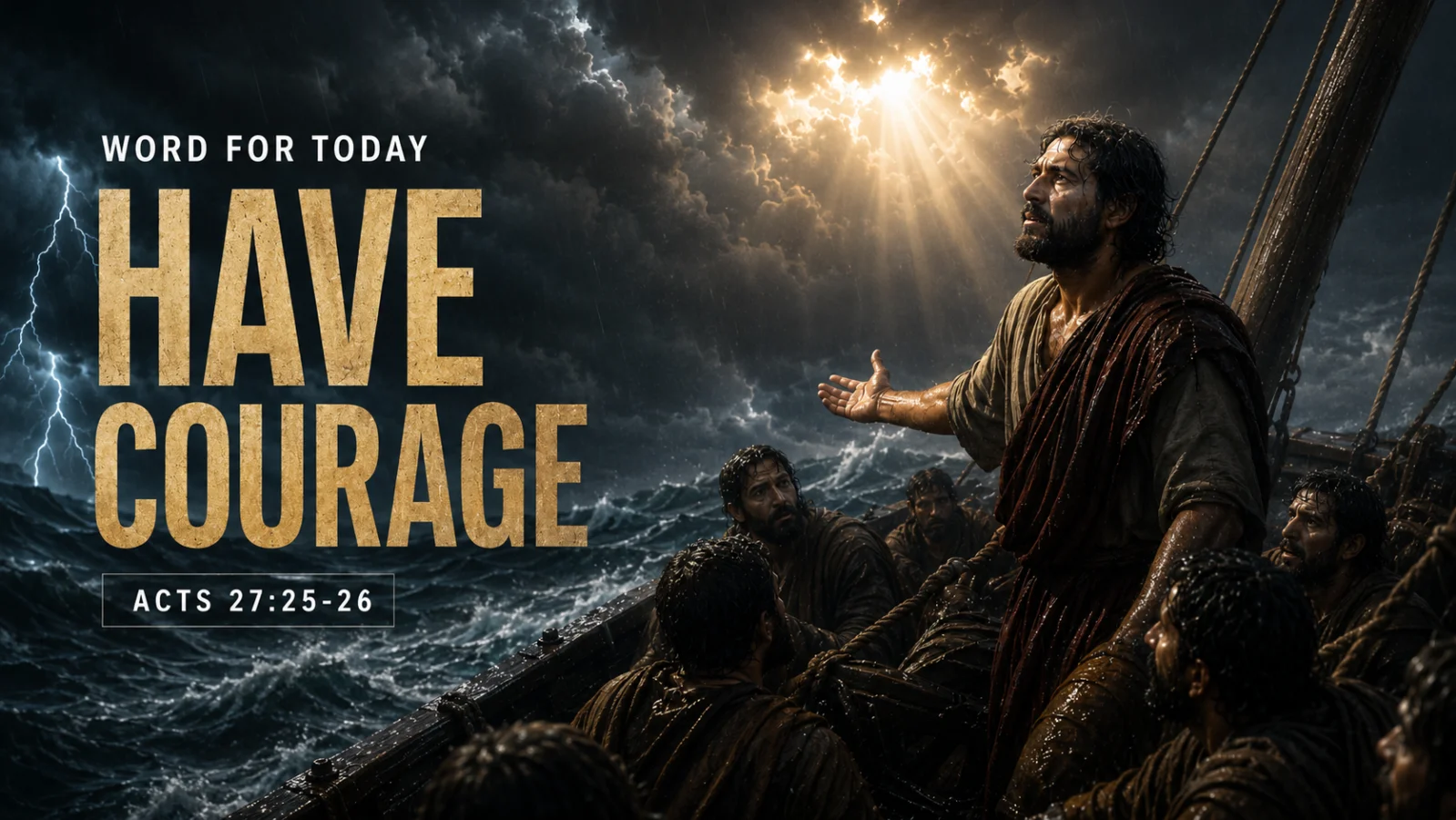
Acts 27 presents one of the most dramatic journeys in the New Testament. Paul was being taken to Rome as a prisoner when the ship carrying him encountered a terrible storm. The storm became so violent that the sailors lost hope of survival. They threw things overboard, went without food for many days, and eventually concluded that all hope was gone.
But in the middle of the storm, Paul stood up with a different message. He said, “Be of good cheer: for I believe God, that it shall be even as it was told me.”
Paul was not denying the storm. He was not pretending that everything was fine. He knew the ship was in danger. Yet he had something stronger than the evidence around him: the word of God.
This is the kind of courage God wants us to have.
1. Have courage because God has spoken
Paul's courage came from a divine promise. An angel had appeared to him and assured him that he would stand before Caesar and that God had granted the lives of everyone travelling with him.
Paul therefore said, “I believe God, that it shall be even as it was told me.”
Notice the foundation of his confidence. Paul did not say, “I believe the sailors.” He did not say, “I believe the weather will improve.” He did not say, “I believe the ship is strong enough.”
He said, “I believe God.”
There will be times when everything around you contradicts what God has said. Your circumstances may say one thing, your emotions may say another, and people may tell you that your situation is impossible. But when God has spoken, His word remains the foundation of your courage.
Faith does not mean that you understand everything. It means that you trust the One who knows everything.
If God has promised you that He will never leave you, have courage.
If God has promised to be your refuge, have courage.
If God has promised to guide you, have courage.
If God has promised that His grace is sufficient, have courage.
The storm may be loud, but God's word is stronger.
2. Have courage even when the storm is real
Paul did not tell the people to have courage because there was no storm. The storm was very real.
Sometimes Christians think that having faith means refusing to acknowledge difficulties. But biblical faith does not ignore reality. It faces reality while trusting God.
Paul knew the ship could be destroyed. He knew they were in danger. Yet he remained confident that God's purpose would stand.
There may be a storm in your life right now.
It may be a financial storm.
It may be a family storm.
It may be a career storm.
It may be a season of disappointment, uncertainty or delay.
The presence of a storm does not mean the absence of God.
Jesus' disciples once found themselves in a storm while Jesus was physically present with them in the boat. The storm did not mean Jesus had abandoned them.
Never measure God's presence by the calmness of your circumstances.
Sometimes God is with you in the storm before He brings you through the storm.
So, do not surrender your faith simply because life has become difficult.
Have courage. God is still with you.
3. Have courage when everyone else has lost hope
One of the remarkable things about Paul's situation was that almost everyone around him had lost hope.
Acts 27:20 says that when neither sun nor stars appeared for many days and the storm continued, “all hope that we should be saved was then taken away.”
Imagine being surrounded by people who have concluded that there is no hope.
Fear is contagious. Discouragement can spread quickly. When everyone around you is afraid, it is easy to become afraid too.
But Paul refused to allow the hopelessness of others to determine his confidence in God.
Sometimes you will have to stand alone in your faith.
People may say, “It cannot happen.”
People may say, “There is no way forward.”
People may say, “Your situation is finished.”
But you must learn to distinguish between the voice of circumstances and the voice of God.
The majority can be wrong.
The situation can look hopeless and God can still make a way.
The door can appear closed and God can still open another.
The storm can become stronger and God can still preserve you.
Do not allow somebody else's fear to become your faith.
Have courage.
4. Courage does not mean there will be no losses
Paul told them that they would survive, but he also said, “Howbeit we must be cast upon a certain island.”
In other words, there would be difficulty along the way.
The ship would be lost, but their lives would be preserved.
This teaches us something important: sometimes God's answer does not preserve everything we wanted to keep.
You may lose the ship, but not your life.
You may lose an opportunity, but not your destiny.
You may lose something valuable, but God may use the experience to bring you into something greater.
Sometimes we become discouraged because we assume that if God is with us, nothing should go wrong.
But God's presence does not mean that everything will happen exactly as we planned.
It means that nothing can ultimately defeat His purpose for our lives.
There are things you may have to let go of. There are seasons you may have to pass through. There are disappointments you may have to endure.
But do not confuse the loss of a ship with the loss of God's purpose.
The ship may sink, but God's promise will not sink.
5. Have courage because God can preserve you in the middle of chaos
The storm did not only threaten the ship. It threatened every person on board.
Yet God gave Paul a promise concerning their lives.
This means that God's protection does not always require Him to remove the storm immediately. Sometimes He preserves us while the storm is still raging.
The three Hebrew men were preserved in the fiery furnace.
Daniel was preserved in the lions' den.
The disciples were preserved in the storm.
Paul and the passengers of the ship were preserved through the violent sea.
God is able to keep you when you cannot keep yourself.
You may not know how everything will work out, but you can know who holds you.
You may not know what tomorrow will bring, but you can trust the God who is already there.
Your confidence should not be in your ability to control the storm. Your confidence should be in God's ability to sustain you through it.
6. Have courage because the storm is not the end of the story
The storm was not the final chapter of Paul's journey.
God had already told him that he would stand before Caesar. Therefore, the storm could not be the end.
This is one of the strongest reasons to have courage.
If God still has a purpose for you, your present storm cannot write your final chapter.
The storm may interrupt your journey, but it cannot cancel God's purpose.
The ship may break apart, but Paul will still reach the shore.
The circumstances may change, but God's word remains.
There are seasons when you may feel as though your life is falling apart. But remember: broken pieces can still bring you to the place God has appointed for you.
Paul eventually reached the island of Malta. What looked like a disaster became part of God's larger plan.
Sometimes the very experience you are asking God to remove may become the pathway through which He reveals His power.
Therefore, do not give up because of what you see today.
Your story is not finished.
Conclusion
Paul's message in the middle of the storm was simple:
“Be of good cheer: for I believe God.”
That is the heart of Christian courage.
Courage says, “I see the storm, but I still believe God.”
Courage says, “I do not understand everything, but I trust God.”
Courage says, “The situation looks impossible, but God is still able.”
Courage says, “I may lose some things, but I will not lose my faith.”
Courage says, “The storm is not the end of my story.”
You may be facing something today that looks bigger than you. You may not know how the situation will end. But remember Paul's words: “I believe God.”
Your courage is not based on how strong you are.
Your courage is based on how faithful God is.
So, lift your head.
Strengthen your heart.
Hold on to God's word.
Keep praying.
Keep believing.
Keep moving.
Have courage.
The storm may be raging, but God is still in control.
The ship may be shaking, but God's promise is standing.
The night may be long, but morning is coming.
And if God has spoken, you can confidently say:
“I believe God, that it shall be even as it was told me.”