
Meditate on God's Word
Take a few quiet moments to reflect on today's message. Allow the Holy Spirit to speak to your heart as you read.
Reading time
7 min read
Introduction
One of the greatest challenges in the life of a believer is learning to trust God even when circumstances seem to contradict His promises. Many people pray, but few can remain confident while waiting for the answers to their prayers. They believe God can do something today, but tomorrow, when difficulties arise, their confidence begins to fade.
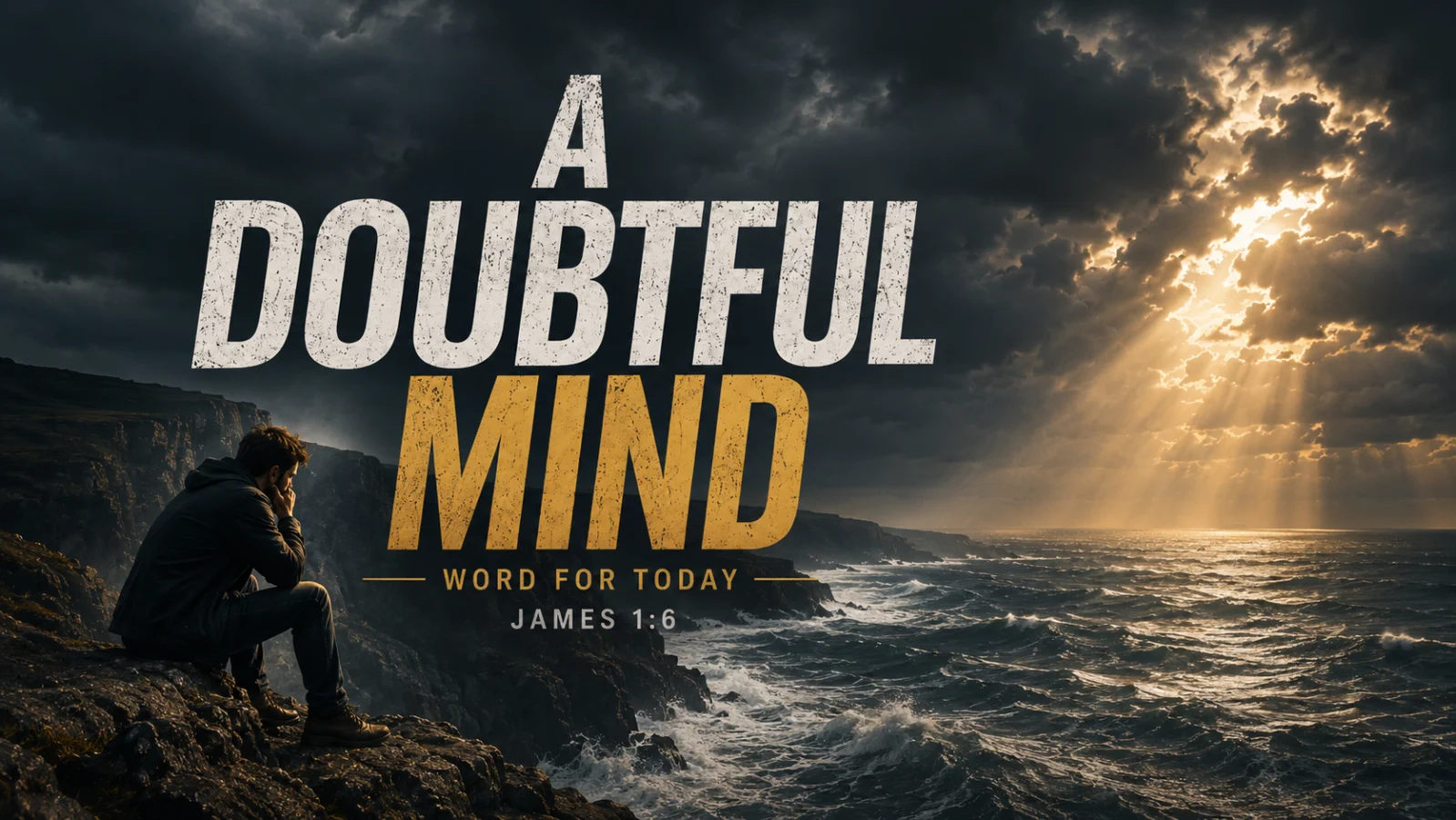
James 1:6 teaches us that when we ask God for wisdom, help, direction, or intervention, we must ask in faith without wavering. This does not mean that believers will never experience fear, questions, or moments of weakness. Rather, it means that we must not allow uncertainty to rule our hearts and determine our relationship with God.
A doubtful mind is a mind that struggles to remain settled in God's ability, faithfulness, and promises. Such a mind is easily influenced by circumstances, people's opinions, and the apparent delay of God's answers. God wants us to develop a faith that remains firm even when we cannot see what He is doing.
1. Doubt Makes a Person Unstable
James compares a person who doubts to a wave of the sea driven by the wind and tossed about. The waves have no fixed direction because they are controlled by the wind. In the same way, a person who constantly doubts God can be moved by every new circumstance.
When things are going well, such a person believes God is faithful. However, when challenges arise, fear takes over, and the same person begins to question God's presence. This instability can affect decisions, relationships, prayer, and spiritual growth.
God wants His children to develop spiritual stability. Our confidence must not depend entirely on what we see or feel. Even when circumstances change, we can remain confident that God is faithful and His wisdom is greater than ours.
Scripture: Ephesians 4:14.
2. Doubt Shifts Our Attention from God to Our Problems
When Peter walked on the sea towards Jesus, he was able to walk on the water while his attention remained on the Lord. But when he saw the wind, he became afraid and began to sink (Matthew 14:28-31).
The wind was real, and the storm was real, but Peter's attention shifted from the One who had called him to the danger surrounding him. This is often how doubt begins. We focus so much on the size of our problems that we lose sight of the greatness of our God.
There are times when the evidence before us may suggest that nothing will change. Yet, faith reminds us that our present situation does not define the limits of God's power. We must acknowledge our challenges without allowing them to become greater in our minds than the God we serve.
Do not spend so much time studying the storm that you forget the One who can sustain you through it. Keep your eyes on Christ, continue in prayer, and trust Him even when the way forward is not clear.
Scripture: Hebrews 12:2.
3. Doubt Weakens Our Confidence in God's Word
God's Word provides a foundation for our faith. When we allow doubt to dominate our hearts, we may begin to question the very promises that once gave us hope. We hear God's Word, but fear tells us that it cannot work in our situation.
The devil's strategy in the Garden of Eden began with a question designed to create uncertainty about what God had said (Genesis 3:1). This reminds us to be careful about the thoughts and voices we entertain. Not every thought that enters our minds deserves our agreement.
Faith does not mean pretending that difficulties do not exist. It means choosing to trust God's character and Word in the middle of those difficulties. When your feelings contradict God's truth, return to Scripture and allow His Word to strengthen your heart.
Do not build your confidence solely on emotions, because emotions can change. Build it on the faithfulness of the God who does not change.
Scripture: Romans 10:17.
4. Learn to Trust God Even When the Answer Is Delayed
One reason people develop a doubtful mind is that they expect God to answer at their preferred time. When the answer delays, they begin to wonder whether God has heard them or whether their prayers are making any difference.
Abraham and Sarah waited many years for the promised son. The passing of time presented a human reason to doubt, yet God's promise was not cancelled by the delay (Genesis 21:1-2). Their story reminds us that God's timing does not always follow our expectations.
Waiting can be difficult, particularly when the matter concerns our family, health, ministry, career, or future. Nevertheless, we must learn to wait without abandoning our confidence in God. A delay is not, by itself, proof that God has rejected you.
Continue to pray, obey God's Word, and take the steps He has placed before you. Faith does not require you to know when the answer will come. It calls you to trust God while you wait.
Scripture: Hebrews 10:35-36.
5. Strengthen Your Faith Through Prayer and God's Word
A doubtful mind does not become a settled mind through positive thinking alone. We need a growing relationship with God, a deeper understanding of His Word, and a willingness to bring our fears honestly before Him.
Even the father who brought his child to Jesus cried out, “Lord, I believe; help thou mine unbelief” (Mark 9:24). His words teach us that when our faith feels weak, we should not run away from God. We should come closer to Him and ask for help.
Prayer helps us surrender our anxieties to God, while Scripture reminds us of His character, promises, and past faithfulness. Fellowship with mature believers can also encourage us when our hearts feel overwhelmed.
Therefore, when doubt begins to rise, do not feed it with endless fear and negative expectations. Turn to God in prayer, meditate on His Word, and take the next faithful step. Spiritual maturity grows as we repeatedly learn to depend on Him.
Scripture: Philippians 4:6-7.
6. Choose Faith Over Fear
Faith is not the absence of every fearful thought. It is the decision to place our trust in God rather than allow fear to control us. There may be moments when we do not understand what God is doing, but we can still trust who He is.
A person who chooses faith does not deny reality. Instead, that person recognises that reality is greater than personal strength or human ability, and that God remains sovereign. When fear says, “You cannot make it,” faith responds, “God will give me the strength to face what lies ahead.”
Remember that doubt can discourage you from taking necessary steps, pursuing God's direction, or continuing a good work. Faith encourages you to act wisely, obey God, and persevere even when the outcome is uncertain.
Today, make a conscious decision not to let fear write the story of your life. You may not have every answer, but you can still walk with God one step at a time.
Scripture: 2 Corinthians 5:7.
Conclusion
James 1:6 calls us to ask God in faith, without wavering like a wave driven by the wind. A doubtful mind is easily shaken by circumstances, but a heart that learns to trust God can remain steady through uncertainty.
You may have questions about your future. You may be waiting for an answer to prayer, facing an unexpected challenge, or wondering how a difficult situation will end. Do not allow these experiences to convince you that God has abandoned you.
Remember that faith is not a guarantee that everything will happen exactly as you desire. Rather, it is confidence in God's character, wisdom, and faithfulness, even when His ways are beyond your understanding.
Do not allow what you cannot see to destroy your confidence in the God you know. Pray in faith, stand on His Word, and keep trusting Him.